
Ventral & Incisional Hernia Repair • Katy & Sugar Land
Ventral & Incisional Hernia Repair in Katy & Sugar Land, TX
Abdominal Wall Hernia Surgery — Open, Laparoscopic & Robotic
A ventral hernia is any hernia through the front wall of the abdomen. When it develops at the site of a previous surgical incision it is called an incisional hernia, and incisional hernias are the most common type. Both appear as a bulge on the abdomen that becomes more obvious when standing, coughing, or lifting.
These hernias range from a small defect that can be closed in under an hour to a wide separation of the abdominal wall that requires a planned reconstruction. Dr. Murtaza Shakir, board certified in General Surgery and Complex General Surgical Oncology, evaluates each one with examination and, when needed, CT imaging, and repairs them using open, laparoscopic, or robotic techniques according to the size, location, and history of the defect.
This page explains the difference between ventral and incisional hernias, why they develop, how repair is planned, and what recovery involves. For all hernia services, see the main hernia repair page.
Board-Certified
General Surgeon and Surgical Oncologist
⭐ Rated 5 Stars
by Patients on Google
2 Convenient Locations
Katy & Sugar Land, TX
Complex Abdominal Wall Repair
Ventral & Incisional Hernias — Request a Consultation
Understanding the Condition
Ventral vs. Incisional Hernia
Two names for hernias of the abdominal wall
Ventral hernia is the broad term. It covers any hernia through the front abdominal wall other than the groin: hernias at the navel (umbilical), above the navel along the midline (epigastric), at the side of the abdomen (Spigelian), and at old incisions.
Incisional hernia is a ventral hernia that has developed where a previous operation cut through the abdominal wall. Once the incision heals, the scar is never as strong as the original muscle and fascia, and roughly one in five to one in ten abdominal incisions eventually develops a hernia, sometimes years later.
The distinction matters because incisional hernias are more likely to be large, to involve multiple defects along the scar, and to be surrounded by scar tissue that complicates repair. Read more about incisional hernias after surgery and ventral hernia causes.
Why the abdominal wall gives way
- A previous incision that healed with a weak scar
- Wound infection after the original surgery
- Obesity, which loads the wall with constant pressure
- Smoking, which impairs tissue strength and healing
- Diabetes, steroid use, or poor nutrition
- Chronic coughing, constipation, or heavy lifting
- Multiple operations through the same area
- Emergency surgery, where the wall may have been closed under difficult conditions
Several of these can be addressed before repair, and doing so lowers the chance of the hernia returning.
Recognizing the Signs
Symptoms of a Ventral or Incisional Hernia
Symptoms depend on the size of the defect and what is passing through it. Large hernias can be surprisingly painless; small ones with a tight opening can be quite uncomfortable.
A bulge on the abdomen or along a surgical scar
Bulge that enlarges when standing, coughing, or straining
Pulling, pressure, or aching at the site
Pain with lifting, bending, or getting out of bed
A bulge that has grown over months or years
Skin over the bulge becoming thin or shiny
Bloating or changes in bowel habit
Difficulty pushing the bulge back in
Large abdominal wall hernias can affect posture, core strength, and breathing, and can make daily activities and exercise difficult. Symptoms usually progress rather than improve; adult ventral hernias do not close on their own. See ventral hernia pain and symptoms.
When an Abdominal Wall Hernia Needs Urgent Care
Intestine can become trapped in a ventral or incisional hernia. Seek immediate care for:
- Sudden, severe pain at the hernia
- A bulge that is firm, very tender, red, or purple
- A hernia that will no longer go back in
- Vomiting, bloating, or inability to pass gas or stool
- Fever with a painful bulge
Call 911 or go to the nearest emergency department if these occur.
A Careful Surgical Evaluation
How Dr. Shakir Plans an Abdominal Wall Repair
Ventral and incisional hernias are measured, mapped, and planned before the operating room. The plan determines the approach, the mesh, and the recovery.
01
Examination
Assessment of the bulge standing and lying, the length of the old scar, the number of defects that can be felt, the quality of the surrounding muscle, and the condition of the skin. Rectus diastasis and previous mesh are noted.
02
CT Imaging
A CT scan is recommended for most incisional hernias and any ventral hernia that is large, recurrent, or difficult to examine. It measures the defect width, identifies additional hidden defects, shows the position of old mesh, and helps Dr. Shakir judge whether the muscles can be brought back together.
03
Previous Operative Reports
Knowing how the original incision was closed, whether mesh was used, and what was done at any previous repair directly changes the plan.
04
Defect Size and Number
Defects under about 4 cm are usually straightforward minimally invasive repairs. Wider defects, multiple defects along a long scar, or loss of abdominal wall domain call for a reconstruction that restores the midline rather than simply patching the hole.
05
Risk Optimization
Weight, smoking, blood sugar, and nutrition are the modifiable factors that most influence whether a repair holds. Dr. Shakir may recommend a preparation period before an elective repair of a large defect.
06
Choosing the Technique
With the defect mapped and the patient prepared, the choice between open, laparoscopic, and robotic repair, and the type and position of mesh, is made and explained before surgery.
Bulge Along an Old Surgical Scar?
Incisional hernias tend to enlarge. A consultation with CT mapping will show exactly what you are dealing with and what repair will hold.

Treatment Options
Ventral Hernia Repair Techniques
The technique is chosen by defect size, location, previous surgery, and patient factors. Mesh is used in nearly all adult ventral and incisional hernia repairs.
Open Repair
Performed through an incision over the hernia, often along the old scar. The hernia is reduced, the defect is closed, and mesh is placed between the layers of the abdominal wall.
Open repair is the approach for very large defects, for cases requiring removal of old mesh or excess skin, and for reconstructions that use component separation to release the muscles and bring the midline back together.
Laparoscopic Repair
Three to five small incisions on the side of the abdomen. The hernia contents are freed from inside and a mesh is fixed against the inner abdominal wall, overlapping the defect widely. Well suited to small and medium defects in patients without extensive prior surgery. Laparoscopic vs. open.
Robotic Repair
The approach Dr. Shakir most often recommends for small to medium ventral and incisional hernias. Through the same small incisions, the wristed instruments allow the defect to be sutured closed and the mesh placed within the abdominal wall layers rather than against the intestine, without a large incision. See robotic hernia repair.
Complex Repairs
Mesh and Abdominal Wall Reconstruction
Mesh Placement in Ventral Hernia Repair
For abdominal wall hernias, where the mesh sits is as important as whether it is used. Options include mesh placed on top of the muscle (onlay), within the layers of the abdominal wall (sublay or retromuscular), or inside the abdomen against the peritoneum (intraperitoneal).
Retromuscular placement, where the mesh is sandwiched behind the rectus muscles and away from the bowel, has the strongest track record for durability and is the goal of most open and robotic repairs. Dr. Shakir explains the mesh type and position for your repair before surgery.
Complex Abdominal Wall Reconstruction
When a defect is too wide to close directly, the muscles can be released from their attachments (component separation) so that they slide toward the midline and can be sutured together, restoring a functional abdominal wall reinforced with a large mesh.
These are planned operations that involve a hospital stay and a longer recovery. They are appropriate for large, recurrent, or multiply operated hernias, and Dr. Shakir’s fellowship training in complex abdominal surgery is directly applicable. See also recurrent hernia repair.
After Surgery
Recovery and Durability
Recovery after ventral or incisional hernia repair
Small to medium minimally invasive repairs. Usually home the same day or after one night. Expect abdominal soreness and a bloated feeling for several days; walking from day one; showering after 24 to 48 hours. Desk work within one to two weeks; lifting limited to about 10 to 15 pounds for four to six weeks.
Large open reconstructions. A hospital stay of two to five days is typical. Drains may be placed and removed at follow-up, and an abdominal binder is worn for support. Lifting restrictions commonly extend to six to eight weeks or longer, and full recovery of core strength takes several months.
Every plan is individualized. Our pre-operative and post-operative guides cover the general instructions; Dr. Shakir provides the specific timeline for your operation.
Can a repaired ventral hernia come back?
It can. Ventral and incisional hernias recur more often than groin hernias, particularly when the defect was large, when mesh was small or placed on top of the muscle, or when the patient smokes, is significantly overweight, or has diabetes.
Three things lower the risk: closing the defect rather than only bridging it with mesh, placing a mesh with wide overlap in the retromuscular position, and addressing weight, smoking, and blood sugar before surgery. Dr. Shakir builds all three into the plan whenever the situation allows.
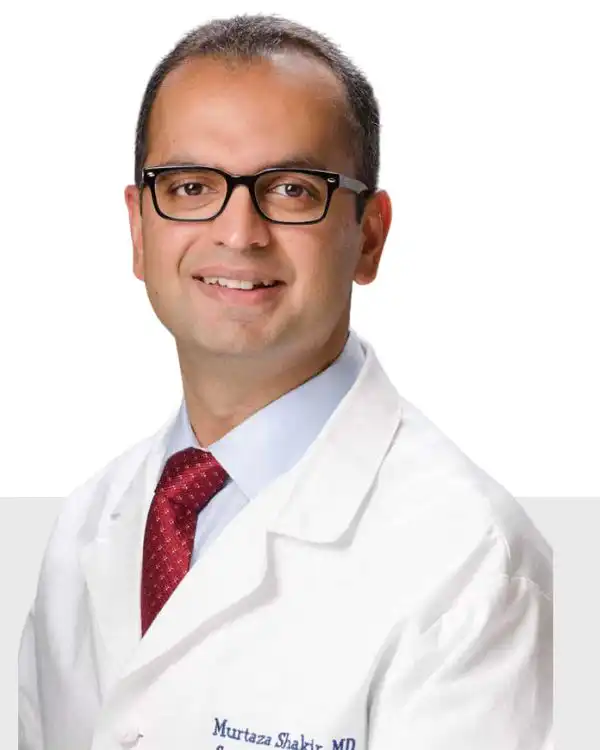
Your Surgeon
Meet Your Abdominal Wall Surgeon
Murtaza Shakir, MD
Dr. Shakir is a board-certified General Surgeon and Surgical Oncologist. He earned his medical degree at Aga Khan University, completed General Surgery residency at Riverside Methodist Hospital in Columbus, Ohio, and a two-year Surgical Oncology fellowship at the University of Pittsburgh Medical Center, where large abdominal operations and their reconstruction were part of daily practice.
He performs the full range of ventral and incisional hernia repair, from robotic repair of small defects to open component separation for large reconstructions.
Board certified by the American Board of Surgery in:
- General Surgery
- Complex General Surgical Oncology
Surgical focus:
- Ventral, incisional, and epigastric hernia repair
- Robotic and laparoscopic abdominal wall repair
- Open reconstruction with component separation
- Recurrent and multiply operated hernias
Recognized by Houstonia Magazine among Houston’s top general surgeons. Learn more about all hernia repair services.
Why Patients Choose Us
Why Choose Surgical Associates of Southern Texas for Ventral & Incisional Hernia Repair?
Board-Certified Surgical Expertise
Board certified in both General Surgery and Complex General Surgical Oncology.
Complex Abdominal Wall Experience
From small ventral defects to open reconstruction of large incisional hernias.
CT-Based Planning
Defects are measured and mapped before surgery, not discovered during it.
Open, Laparoscopic & Robotic
The technique fits the defect, the prior surgery, and the patient.
Clear Communication
Mesh type, mesh position, hospital stay, and recovery are explained before you decide.
Katy & Sugar Land Offices
Consultations and follow-up at two Fort Bend County locations.
Locations
Two Convenient Fort Bend County Offices
Consultations for ventral and incisional hernias, including imaging review and second opinions, are available at both offices. View all locations.
Katy Office
Convenient for patients from Katy, Cinco Ranch, Fulshear, Richmond, and West Houston.
Surgical Associates of Southern Texas
410 W Grand Pkwy S
Suite 4D
Katy, TX 77494
Abdominal wall hernia evaluation, CT review, and planning for open, laparoscopic, or robotic repair.
Sugar Land Office
Convenient for patients from Sugar Land, Richmond, Stafford, Missouri City, and Fort Bend County.
Surgical Associates of Southern Texas
17510 W Grand Pkwy S
Suite 320
Sugar Land, TX 77479
Abdominal wall hernia evaluation, CT review, and planning for open, laparoscopic, or robotic repair.
Patient Reviews
What Patients Say About Hernia Repair
⭐⭐⭐⭐⭐ Rated 5 Stars by Patients on Google. Real experiences from patients treated in Katy and Sugar Land.

Jide Eboh
Houston · Hernia Repair
Surgical associates of Southern Texas is a great practice with amazing medical assistants, staff, and a great surgeon. Dr.Murtaza did a routine and successful Hernia repair with no complications. The staff was very kind and accompanying of my schedule as I am constantly out of town. I would recommend him to anyone searching for a general surgeon.
Maryna Solodka
Katy
Dr Shakir literally turned my life to the better! The level of professionalism and care he treated me with was the top, which is hard to meet nowadays in the digital world we live in. Dr. Shakir patiently answered all my questions before the surgery to ensure I knew what is and will be happening and so I could feel in peace. If you ever need to go through such life changing event like internal organ surgery I recommend you reach out to Dr Shakir so he can go through those changes with you!
See what more patients are saying about their experience with Dr. Shakir.
FAQ
Ventral & Incisional Hernia Questions
What is the difference between a ventral and an incisional hernia?
Ventral hernia is the general term for any hernia through the front abdominal wall. An incisional hernia is a ventral hernia that has formed at a previous surgical incision. Incisional hernias are the most common type of ventral hernia.
Why did I develop a hernia after abdominal surgery?
A healed incision is never as strong as the original abdominal wall. Infection, obesity, smoking, diabetes, steroid use, or strain during healing can weaken the scar further, allowing a hernia to form months or years later.
Can an incisional hernia get larger?
Yes. Incisional hernias almost always enlarge over time as the defect stretches, which makes repair more complex. Early evaluation gives more options.
Can a ventral hernia be repaired robotically?
Yes. Robotic repair is well suited to small and medium ventral and incisional hernias, allowing the defect to be closed and mesh placed within the abdominal wall through small incisions. Very large defects are usually repaired open.
How long is recovery after ventral hernia repair?
For a minimally invasive repair of a small or medium defect: home the same day or next day, desk work in one to two weeks, lifting restricted for four to six weeks. For a large open reconstruction: a hospital stay of several days and lifting restrictions of six to eight weeks or more.
Is mesh always used?
Almost always for adult ventral and incisional hernias, because mesh substantially lowers recurrence. The position of the mesh, ideally behind the rectus muscles, matters as much as the mesh itself.
Do I need a CT scan?
For most incisional hernias and any large, recurrent, or hard-to-examine ventral hernia, yes. It measures the defect, finds hidden defects, and shows old mesh.
What is component separation?
A reconstructive technique in which the abdominal wall muscles are released from their attachments so they can slide toward the midline and be sutured together over a large defect, then reinforced with mesh.
Will I stay in the hospital?
Most minimally invasive repairs are same-day or one-night procedures. Large open reconstructions typically involve a stay of two to five days.
Should I lose weight or stop smoking before surgery?
If either applies to you, yes. Both measurably lower the risk of infection and recurrence. Dr. Shakir may recommend a preparation period before an elective repair of a large defect.
Can a ventral hernia be left alone?
Small, painless ventral hernias in patients with significant surgical risk are sometimes observed. Most symptomatic or enlarging hernias are better repaired electively, because they tend to grow and an emergency repair of a trapped hernia is a harder operation.
Where can I see a ventral hernia surgeon near Katy or Sugar Land?
Dr. Murtaza Shakir sees patients at 410 W Grand Pkwy S, Suite 4D, Katy, TX 77494 and 17510 W Grand Pkwy S, Suite 320, Sugar Land, TX 77479. Call 713-955-9191.
Schedule a Ventral or Incisional Hernia Consultation
If you have a bulge on your abdomen or along a surgical scar, or have been told you need abdominal wall repair, schedule an evaluation with Dr. Murtaza Shakir.
A consultation can help determine:
- Whether the bulge is a ventral or incisional hernia and how large the defect is
- Whether CT imaging is needed to plan the repair
- Which technique — open, laparoscopic, or robotic — fits your defect
- Where the mesh will be placed and why
- What hospital stay, recovery, and lifting restrictions to expect
Serving patients throughout: Katy • Sugar Land • Richmond • Fulshear • West Houston • Greater Houston