
Hernia • Patient Education
Hernia Pain Without a Visible Bulge: Causes, Symptoms, and When to See a Surgeon
Groin or abdominal pain that flares when you lift, cough, or stand for a long time is one of the most common reasons people suspect a hernia. But when there is no lump to point to, it is hard to know whether a hernia is really the cause, whether it is something else entirely, and whether anyone needs to look at it. Hernias can hurt before they can be seen. This article explains why that happens, what hidden hernia pain tends to feel like, which other conditions mimic it, how a surgeon sorts it out, and when treatment may be worth considering.
By Surgical Associates of Southern Texas · Katy and Sugar Land, TX · Updated September 2026
On This Page
- Can a hernia hurt without a bulge?
- Why some hernias stay hidden
- What hidden hernia pain feels like
- Other conditions with similar pain
- When to seek medical care
- How a hidden hernia is diagnosed
- Treatment options
- When surgery may be considered
- What recovery looks like
- Frequently asked questions
- Final takeaway
What You’ll Learn
- Why a hernia can cause pain before any bulge appears
- What hidden hernia pain usually feels like, and what makes it worse
- Other conditions that cause similar groin and abdominal pain
- How a surgeon evaluates a suspected hernia when nothing is visible
- When observation is reasonable, when repair may be recommended, and when to seek care urgently
Can a Hernia Cause Pain Without a Visible Bulge?
Yes. A hernia is an opening in the muscle or connective tissue of the abdominal wall, and the opening can hurt before anything pushes through it far enough to be seen or felt. Fat or a small portion of intestine may slip in and out of the defect intermittently, stretching the tissue and irritating nearby nerves, then retreat when you lie down. The result is pain, pulling, or pressure with no lump to show for it.
This is especially common with early inguinal (groin) hernias, with hernias in people who carry extra weight over the area, and with certain less common hernia types that sit deep in the abdominal wall. Because other conditions can produce nearly identical symptoms, a physical examination, sometimes with imaging, is needed to confirm whether a hernia is actually the cause. Our hernia repair page covers the condition broadly; this article focuses on the situation where pain comes first.
Why Some Hernias Stay Hidden
Several factors explain why a hernia can be painful yet invisible.
The hernia is small or early
Most hernias start small. In the earliest stage the defect may be only a centimeter or two wide, and only a small amount of fat passes through it under strain. That is enough to cause symptoms but not enough to create a bulge you can see in the mirror. Over months or years the opening usually enlarges, and a bulge eventually appears. Pain without a bulge is often simply the first chapter of a hernia that will later become obvious.
The hernia is deep
Some hernias sit beneath thick layers of muscle or fat. Femoral hernias, which occur just below the groin crease, and Spigelian hernias, which occur along the edge of the rectus muscle on the side of the abdomen, are notorious for being felt long before they are seen. Interstitial hernias, where tissue slides between the layers of the abdominal wall rather than through all of them, behave the same way.
Body habitus
In patients with a fuller abdomen or groin, a bulge that would be plain in a slim person may be completely hidden. The symptoms are the same; only the visibility differs.
The hernia reduces on its own
Many hernias slide back in as soon as you lie down or relax. If you only look for a bulge in the morning or in bed, you may never catch it. Hernias are most visible after standing, straining, or a long day on your feet, which is why a surgeon examines patients standing and asks them to cough.
Sports hernia is not a true hernia
“Sports hernia,” or athletic pubalgia, is a strain or tear of the tendons and muscles where they attach near the pubic bone. It causes groin pain with exertion and no bulge, and it is often confused with an inguinal hernia. It is a different condition with different treatment, and distinguishing the two is one of the main reasons an examination matters.
What Hidden Hernia Pain Feels Like
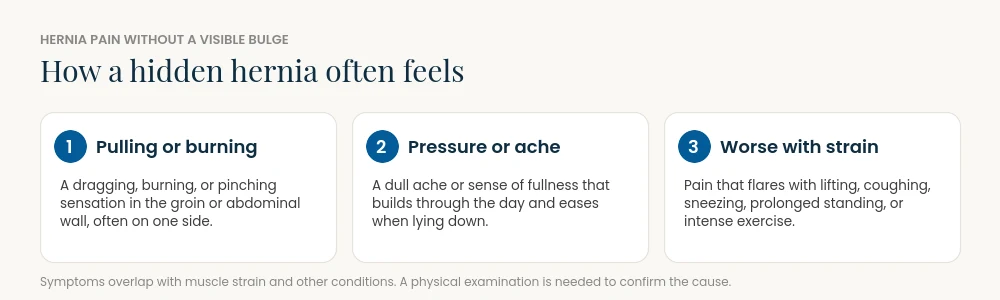
Patients describe hidden hernia pain in remarkably consistent ways. The most common patterns are:
- Pulling, dragging, or burning in the groin, lower abdomen, or around the navel, usually on one side
- A dull ache or pressure that builds over the course of the day and eases with rest or lying down
- Sharp or pinching pain with specific movements: lifting, coughing, sneezing, laughing, bending, or rising from a chair
- Discomfort with prolonged standing or walking, particularly by evening
- Pain radiating toward the inner thigh or, in men, toward the testicle
- A vague sense that “something is there” without being able to find it
The pain is typically worse with anything that raises pressure inside the abdomen and better with anything that relieves it. That relationship to strain is one of the more useful clues that a hernia, rather than a muscle or joint, is responsible. Our articles on when to worry about hernia pain and hernias with no pain at all describe the two ends of the spectrum.
Other Conditions That Cause Similar Pain
Groin and lower abdominal pain without a bulge has a long list of possible causes, and a hernia is only one of them. Conditions that commonly mimic a hidden hernia include:
- Muscle strain of the abdominal wall or adductor muscles of the inner thigh, usually after a specific injury or workout
- Athletic pubalgia (sports hernia), a tendon injury near the pubic bone, common in athletes who cut, twist, or kick
- Hip problems, including labral tears and early arthritis, which often refer pain to the groin
- Nerve entrapment of the ilioinguinal or genitofemoral nerve, causing burning pain in the groin and upper thigh
- Enlarged lymph nodes in the groin from infection or inflammation
- Urologic causes such as kidney stones, epididymitis, or a varicocele
- Gynecologic causes such as ovarian cysts, endometriosis, or round ligament pain during pregnancy
- Osteitis pubis, inflammation of the joint where the pubic bones meet
Several of these can coexist with a hernia. Sorting them out is a matter of history, examination, and occasionally imaging, which is why persistent pain deserves a proper evaluation rather than self-diagnosis. Our guide to relief for groin pain discusses the broader picture.
When to Seek Medical Care
Most hidden hernia pain is not an emergency, but it should not be ignored either. Arrange an evaluation if:
- Pain in the groin or abdomen has persisted for more than two to three weeks
- Pain consistently worsens with lifting, coughing, or standing
- You have noticed an intermittent lump, even if it is not always present
- Pain is affecting work, exercise, or sleep
- You have had a hernia or abdominal surgery before and have new pain near the site
Seek emergency care immediately for sudden, severe abdominal or groin pain, a lump that appears and becomes firm, tender, or discolored, nausea and vomiting with abdominal pain, inability to pass gas or stool, or fever with any of these. These can indicate a hernia that has become trapped (incarcerated) or has lost its blood supply (strangulated), which requires urgent surgery. This can happen even when the hernia was never visible beforehand.
Key Takeaway So Far
Hernias can cause pulling, burning, pressure, or strain-related pain well before any bulge appears, and several other conditions produce similar symptoms. Persistent groin or abdominal pain that worsens with strain warrants an evaluation, and sudden severe pain with a firm lump or vomiting needs emergency care. Next, we cover how a surgeon confirms or rules out a hidden hernia, what the treatment options are, and what recovery involves if repair is recommended.
How a Hidden Hernia Is Diagnosed
Diagnosing a hernia that cannot be seen depends first on a careful examination and then, when needed, on imaging.
Physical examination
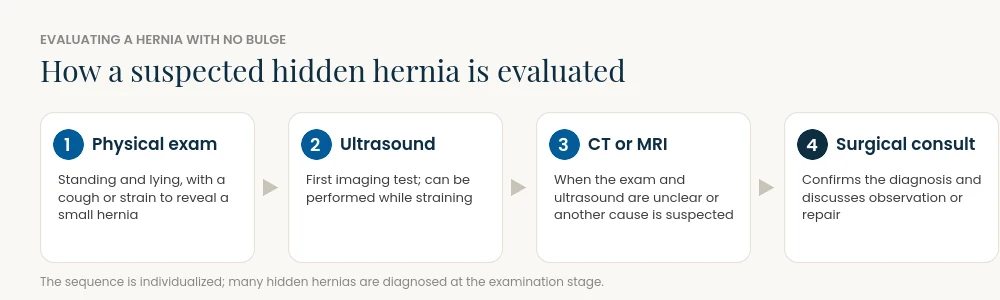
The surgeon examines the groin and abdominal wall with you standing and then lying down, and asks you to cough or bear down. Straining pushes tissue against the defect and often lets the examiner feel an impulse or a small bulge that is not visible at rest. In men, the examiner may gently invert the scrotal skin to feel the inguinal canal directly. The examination also checks the hip, the adductor tendons, the pubic bone, and the lymph nodes, because those are the common mimics. Many hidden hernias are diagnosed at this step.
Ultrasound
When the examination is suggestive but not conclusive, an ultrasound is usually the first test. It is inexpensive, uses no radiation, and, importantly, can be performed while you strain, which allows the technician to see a hernia that only appears under pressure.
CT or MRI
A CT scan is useful when the ultrasound is unclear, when a deep hernia such as a Spigelian or femoral hernia is suspected, or when a non-hernia cause needs to be ruled out. MRI is occasionally used, particularly in athletes, because it shows the tendons and muscles involved in athletic pubalgia as well as any hernia.
What imaging cannot do
A negative scan does not always exclude a small hernia, and a scan that shows a tiny defect does not always explain the pain. The examination and the imaging are read together, and the surgeon’s judgment about whether the findings fit the symptoms is what determines the diagnosis.
Treatment Options
Treatment depends on whether a hernia is confirmed, how much it is affecting you, and your overall health. A hernia does not heal on its own; the question is whether and when to repair it.
Observation
For a small hernia with mild, occasional symptoms, watchful waiting is reasonable for many adults. The risk of a small hernia becoming trapped in any given year is low. Observation means avoiding heavy straining where practical, watching for changes, and returning for review if symptoms increase. It is not usually recommended for femoral hernias or for groin hernias in women, which carry a higher risk of incarceration.
Treating the mimics
If the evaluation points to a muscle strain, athletic pubalgia, or a hip problem rather than a hernia, treatment is usually rest, physical therapy, anti-inflammatory medication, and a gradual return to activity. Athletic pubalgia occasionally needs surgery of its own, but the approach is different from a hernia repair.
Surgical repair
When repair is recommended, three approaches are available. Open repair uses a single incision over the hernia and reinforces the defect with mesh; it suits many first-time groin hernias and can be done under regional anesthesia. Laparoscopic repair uses small incisions and places mesh behind the abdominal wall; it is well suited to hernias on both sides and to hernias that have come back after open surgery. Robotic repair uses the same small incisions with wristed instruments and a 3D view, which helps when suturing the defect closed and placing mesh precisely. The best approach depends on the hernia and the patient, and Dr. Shakir performs all three. Read more about inguinal hernia repair, robotic hernia repair, and umbilical hernia repair.
When Surgery May Be Considered
A surgeon is likely to recommend repair rather than observation when:
- Pain is persistent, progressive, or limiting daily activity, work, or exercise
- The hernia is enlarging, or a bulge has begun to appear
- The hernia has ever become stuck, even briefly
- The hernia is a femoral hernia, or a groin hernia in a woman
- Your work or sport involves regular heavy lifting or straining
- The hernia is at a previous surgical scar and is likely to grow
Repair is a planned, usually outpatient operation. That is a very different experience from an emergency repair of a trapped hernia, which is the main reason surgeons prefer to fix symptomatic hernias electively rather than wait for a crisis. If the hernia has returned after a previous operation, the planning is more involved; see recurrent hernia repair. For hernias along an old incision, see ventral and incisional hernia repair.
What Recovery Looks Like
After a minimally invasive or open repair of a small hernia, most patients go home the same day. Expect soreness for a few days, walking from the first evening, and showering after 24 to 48 hours. Desk work is often possible within about a week; physical work usually takes two to four weeks. Heavy lifting and core exercise are typically restricted for four to six weeks so the repair can heal. Larger or more complex repairs take longer.
Interestingly, patients whose main symptom was pain rather than a bulge often notice the improvement quickly, because the source of the pulling and burning has been addressed. Some post-operative discomfort at the incision and mild bruising are normal and fade over the first couple of weeks. Our pre-operative and post-operative care pages describe the general instructions, and the hernia surgery recovery timeline goes week by week.
Frequently Asked Questions
Can a hernia cause pain without a visible bulge?
Yes. The opening in the abdominal wall can hurt before enough tissue pushes through it to be seen. Early, small, deep, or intermittently reducing hernias often cause pulling, burning, or strain-related pain with no lump.
How can I tell the difference between a hernia and a pulled muscle?
A pulled muscle usually follows a specific injury, hurts when the muscle is stretched or contracted, and improves steadily over a few weeks. Hernia pain is tied to straining and standing, tends to persist or worsen over time, and may come with an intermittent lump. An examination can usually distinguish the two.
Can a hernia be diagnosed without a bulge?
Often, yes. A surgeon examines you standing with a cough or strain, which frequently reveals a hernia that is not visible at rest. Ultrasound performed while straining, or a CT scan, is used when the examination is unclear.
Will a hidden hernia eventually become visible?
Usually. Hernias tend to enlarge over months or years as the defect stretches, and most eventually produce a visible bulge. Some deep hernias remain hard to see even when they are quite large.
Can a hernia heal on its own?
No. Adult hernias do not close by themselves. Symptoms may fluctuate, but the defect remains. Whether it needs repair depends on symptoms, size, type, and your health.
Is it safe to wait if I have hernia pain but no bulge?
For a small, mildly symptomatic hernia in a healthy adult, watchful waiting is often reasonable after a surgeon has confirmed the diagnosis. It is less appropriate for femoral hernias, groin hernias in women, or hernias that have ever become stuck.
What kind of doctor should I see for groin pain without a lump?
A primary care physician is a reasonable first step for undifferentiated groin pain. If a hernia is suspected, a general surgeon is the specialist who confirms the diagnosis and discusses treatment. Hip or tendon problems may be referred to orthopedics or sports medicine.
Can hernia pain come and go?
Yes. Many hernias are intermittently symptomatic, hurting after a strenuous day and settling after rest. Pain that comes and goes is still worth evaluating if it persists over weeks.
What happens if a hidden hernia gets stuck?
Tissue trapped in the defect causes sudden, severe pain and often a firm, tender lump that was not there before, sometimes with vomiting. This is an emergency and requires immediate care, even if the hernia was never visible previously.
Concerned About Hernia Symptoms?
If groin or abdominal pain is persistent, worsening, or affecting daily life, a surgical evaluation can determine whether a hernia is the cause and whether treatment may be appropriate. Dr. Murtaza Shakir sees patients at the Katy and Sugar Land offices.
Final Takeaway
Pain without a bulge does not mean there is no hernia, and it does not mean there is one. What it means is that the cause has not been established, and it should be. A single examination by a surgeon, with an ultrasound when needed, usually settles the question. If it is a hernia, you will learn whether watching is reasonable or repair is advisable and what that involves. If it is not, you will be pointed toward the right treatment for what is actually causing the pain. Either way, weeks of guessing are replaced by a plan.
Patients in Katy, Sugar Land, Richmond, Fulshear, and the wider West Houston area can request a consultation at either of our two Fort Bend County offices.
Medical Disclaimer
This article is intended for general educational purposes only and is not a substitute for professional medical advice, diagnosis, or treatment. Symptoms can have many possible causes, and treatment decisions should be based on an individual medical evaluation. If you are experiencing severe or rapidly worsening symptoms, seek prompt medical attention. For a medical emergency, call 911 or go to the nearest emergency department.
References
- HerniaSurge Group. International guidelines for groin hernia management. Hernia. 2018;22(1):1–165.
- American College of Surgeons. Groin Hernia Repair: Adult Patient Education Program. facs.org.
- Society of American Gastrointestinal and Endoscopic Surgeons (SAGES). Guidelines for laparoscopic ventral hernia repair. sages.org.
- National Institute of Diabetes and Digestive and Kidney Diseases (NIDDK). Inguinal Hernia: Symptoms & Causes; Diagnosis. niddk.nih.gov.
- Mayo Clinic. Inguinal hernia: Symptoms and causes; Diagnosis and treatment. mayoclinic.org.
- Cleveland Clinic. Sports Hernia (Athletic Pubalgia). my.clevelandclinic.org.

Your Surgeon
About the Physician
Murtaza Shakir, MD
Dr. Murtaza Shakir is a board-certified General Surgeon and is board certified in Complex General Surgical Oncology. He earned his medical degree at Aga Khan University, completed General Surgery residency at Riverside Methodist Hospital in Columbus, Ohio, and a two-year Surgical Oncology fellowship at the University of Pittsburgh Medical Center.
He evaluates and repairs hernias, including hernias that cause pain without a visible bulge, at Surgical Associates of Southern Texas in Katy and Sugar Land.
Board certified by the American Board of Surgery in:
- General Surgery
- Complex General Surgical Oncology
Surgical focus:
- Inguinal, umbilical, ventral, and incisional hernia repair
- Open, laparoscopic, and robotic technique
- Recurrent and complex hernias
- Gallbladder and general surgery
Recognized by Houstonia Magazine among Houston’s top general surgeons. Learn more about the physician page.