 EN
 ES
 UR
 HI

Hernia on your CT report?
Have board-certified general surgeon Dr. Murtaza Shakir review your scan and examine you in Katy or Sugar Land. Call (713) 955-9191, or send your details and our team will call you back.
THE SHORT ANSWER
A hernia seen on a CT scan does not automatically mean you need surgery. Small hernias that contain only fat and cause no symptoms can often be watched, while hernias that hurt, grow, contain bowel or have a narrow neck usually need repair. A general surgeon makes that call by examining you and comparing the scan with your symptoms.
What Do the Words on My CT Report Mean?
The words on a CT report describe where the hernia is, what is inside it and how wide the opening is, and those details shape the surgeon’s advice. Radiologists write for other doctors, so the wording can sound more alarming than the finding really is. These are the terms patients ask about most:
- Fat-containing hernia: only fatty tissue passes through the opening. These are often small and may cause few symptoms.
- Bowel-containing hernia: a loop of intestine passes into the hernia. These generally deserve a prompt surgical opinion.
- Defect size or neck: the width of the opening in the abdominal wall. A narrow neck with bowel inside can be more likely to trap tissue.
- No evidence of obstruction or strangulation: the radiologist saw no sign of a blocked or compromised bowel at the time of the scan. It describes that moment, not a guarantee for the future.
- Diastasis recti: a widening between the abdominal muscles. It can look like a bulge but is not a true hernia and often does not need surgery.
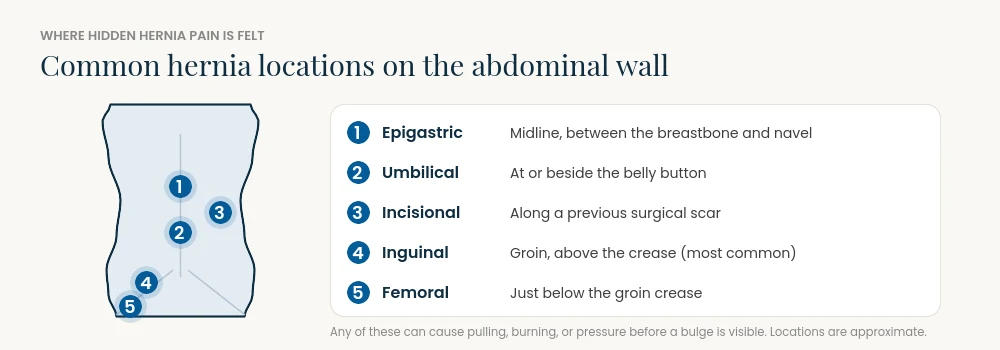
The report also names the location, such as inguinal (groin), femoral, umbilical (belly button), ventral or incisional (through an old surgical scar). Location matters because some types, especially femoral hernias, are more likely to trap tissue.
How Do Surgeons Decide Whether a Hernia on CT Needs Repair?
Surgeons decide by combining three things: what you feel, what the exam shows and what the scan shows. A CT image alone rarely settles the question.
- Your symptoms: pain, pressure, a bulge that comes and goes, and whether the hernia limits work, lifting or exercise.
- The physical exam: we examine you lying down and standing, and while you cough or strain, to see how the hernia behaves and whether it pushes back in easily.
- The scan details: what the hernia contains, the size of the opening and whether it has grown compared with any earlier scan.
- Your overall health: other medical conditions, medications and how well you are likely to tolerate surgery all factor into the timing.
Sometimes an ultrasound adds detail, but for most patients the existing CT and a careful exam are enough to make a plan.
When Is Repair Usually Recommended?
Repair is usually recommended when a hernia causes symptoms, is getting bigger or has features that raise the risk of tissue becoming trapped. Surgeons weigh the hernia type and location together with how you feel. Repair is commonly advised when:
- The hernia causes pain or pressure, or limits work or exercise
- It has grown since an earlier scan or exam
- It contains bowel, or has a narrow neck
- It is a femoral hernia, which carries a higher risk of trapping tissue
- It is an incisional or recurrent hernia that is enlarging
For a small, painless groin hernia, watchful waiting can be reasonable. Many of these hernias eventually become symptomatic and are repaired later: the National Institute of Diabetes and Digestive and Kidney Diseases notes that about 70 percent of men who delay inguinal hernia surgery develop new or worsening symptoms and need surgery within 5 years. See when hernia surgery becomes necessary for more detail.
What Does Watchful Waiting Involve?
Watchful waiting means planned monitoring, not ignoring the hernia. The hernia will not close on its own, so the goal is to repair it at the right time rather than in an emergency.
- Know where the hernia is and what it normally feels like
- Watch for a bulge that gets larger, becomes harder to push back in, or starts to hurt
- Keep follow-up visits so the surgeon can recheck the hernia
- Ask what activity limits, if any, apply to you
If symptoms change, call the office sooner rather than waiting for the next visit. Read more on whether hernias go away on their own.
Have a CT Report Mentioning a Hernia?
Bring it to a consultation with board-certified general surgeon Dr. Murtaza Shakir in Katy or Sugar Land, and leave with a clear plan to repair or watch.
Can I Have a Hernia on CT but No Bulge?
Yes. CT scans are done lying down and show the layers of the abdominal wall in detail, so small hernias can show up even when nothing is visible in the mirror. Deep or small groin hernias, and hernias in people with more abdominal fat, often cannot be seen from outside.
The surgeon will examine you standing and while you cough or strain, and sometimes an ultrasound adds detail. A hernia you cannot see can still cause aching or pressure, especially with lifting or at the end of the day. Read about hernia pain without a visible bulge.
When Is a Hernia an Emergency?
A hernia is an emergency when tissue becomes trapped and cannot be pushed back in, because its blood supply may be cut off. Go to the emergency room or call 911 if the area of a hernia:
- Becomes firm, very painful or tender, red or dark
- Suddenly gets larger and you cannot push it back in
- Comes with nausea, vomiting, a swollen belly, fever, or inability to pass gas or have a bowel movement
These can signal an incarcerated or strangulated hernia, where tissue is trapped and may lose its blood supply. A strangulated hernia needs urgent surgery. Most hernias found on CT are not emergencies, but knowing these signs is part of any plan to watch a hernia. See also when to worry about hernia pain.
What Happens at the Surgical Consultation?
At the consultation, the surgeon matches your scan to your symptoms and exam and gives you a clear plan. Bring the CT report and, if possible, the images on disc. Dr. Shakir will ask about your symptoms, examine you and review the scan himself.
You will leave with one of three plans:
- Repair now, usually for painful, enlarging or bowel-containing hernias
- Schedule repair later, at a time that fits your work and health
- Keep watching, with clear instructions on what to look out for
If repair is recommended, he will explain whether a robotic, laparoscopic or open approach fits your hernia and whether mesh is advised. Groin hernias are covered in more detail on the inguinal hernia repair page, and hernias through old incisions on the ventral and incisional hernia repair page.
How Do Patients in Katy, Sugar Land and Houston Get a CT Finding Reviewed?
The simplest path is to request your CT report and images from the hospital, ER or imaging center that did the scan, then book a surgical consultation. Many hernias in the Houston area are first found during an ER visit or a scan ordered for another problem, so the report may arrive weeks before anyone talks to you about it.
- Ask the facility for the written report and a disc or electronic copy of the images
- Write down when you first noticed symptoms and what makes them better or worse
- Bring a list of your medications and prior abdominal surgeries
Dr. Shakir sees patients at offices in Katy and Sugar Land. Call (713) 955-9191 or request an appointment.
Questions to Ask Your Surgeon About a Hernia Found on CT
- What does my hernia contain, and how wide is the opening?
- Does my exam match what the CT scan shows?
- Is my hernia safe to watch, or do you recommend repair now?
- If we watch it, which changes should make me call you or go to the ER?
- Do I need an ultrasound or another scan before deciding?
- If I need repair, would you use a robotic, laparoscopic or open approach, and is mesh advised?
Frequently Asked Questions
Should I be worried if my CT scan shows a hernia?
Most hernias found on CT are not emergencies. Schedule a surgical consultation, and seek emergency care only if the area becomes painful, hard and stuck, or you have vomiting and cannot pass gas.
Can a hernia seen on CT go away?
No. Adult hernias do not close on their own. They may stay the same for a long time, but the opening in the abdominal wall remains.
Is a fat-containing hernia dangerous?
It is usually less concerning than one containing bowel, especially if it is small and painless. It still deserves an exam to decide whether watching or repair is best.
Do I need another scan before hernia surgery?
Often not. Your existing CT is usually enough for planning. Occasionally an ultrasound or an updated scan is helpful for complex or recurrent hernias.
Is diastasis recti on my CT report the same as a hernia?
No. Diastasis recti is a widening between the abdominal muscles without a true opening in the wall. It can look like a bulge but often does not need surgery. A surgeon can tell the two apart on exam and imaging.
Key Takeaway
A hernia on your CT report is a reason for a surgical consultation, not automatically for surgery. Symptoms, size, what the hernia contains and its type determine whether repair is recommended now or later. A firm, painful hernia that will not go back in, especially with vomiting, needs emergency care.
Sources and Further Reading
- Hernia, MedlinePlus (U.S. National Library of Medicine)
- Inguinal Hernia, National Institute of Diabetes and Digestive and Kidney Diseases (NIDDK)
- Ventral Hernia, Cleveland Clinic
This article is general education, not personal medical advice. For severe abdominal pain, fever with abdominal pain, heavy bleeding, or yellowing of the skin or eyes, seek emergency care.

Meet the Surgeon
Dr. Murtaza Shakir is a board-certified General Surgeon and is board certified in Complex General Surgical Oncology. He earned his medical degree at Aga Khan University, completed General Surgery residency at Riverside Methodist Hospital in Columbus, Ohio, and a two-year Surgical Oncology fellowship at the University of Pittsburgh Medical Center. He sees patients at Surgical Associates of Southern Texas in Katy and Sugar Land.
Related Reading and Care
Schedule a Hernia Evaluation
Bring your CT report to our Katy or Sugar Land office and find out whether repair is recommended now, later or not at all.
This page provides general information and is not a substitute for medical advice. For severe abdominal pain or other emergencies, call 911 or go to the nearest emergency room. Last updated October 16, 2026.