
Houston General Surgery
General Surgeon Serving Houston, TX
Hernia, Gallbladder, Appendix, Reflux, Skin and Cancer Surgery for Houston Patients, With Offices in Katy and Sugar Land
A bulge that keeps coming back, pain under the right ribs after meals, a lump that is growing, or an emergency room visit that ended with “see a surgeon” are common reasons Houston patients look for a general surgeon. A general surgeon works out whether the problem needs an operation and, if it does, performs it. Houston patients are seen at our Katy and Sugar Land offices; the practice has no office inside Houston city limits.
At Surgical Associates of Southern Texas, Dr. Murtaza Shakir, board certified in General Surgery and Complex General Surgical Oncology, evaluates and treats hernias, gallstones and gallbladder disease, appendicitis, reflux, hemorrhoids, skin lumps, slow-healing wounds and several cancers. He uses open, laparoscopic and robotic techniques. This page is a starting point for Houston patients: where you are seen, which services are offered and how to get an appointment. New patients are welcome. For a full overview of the specialty, see our general surgery page.
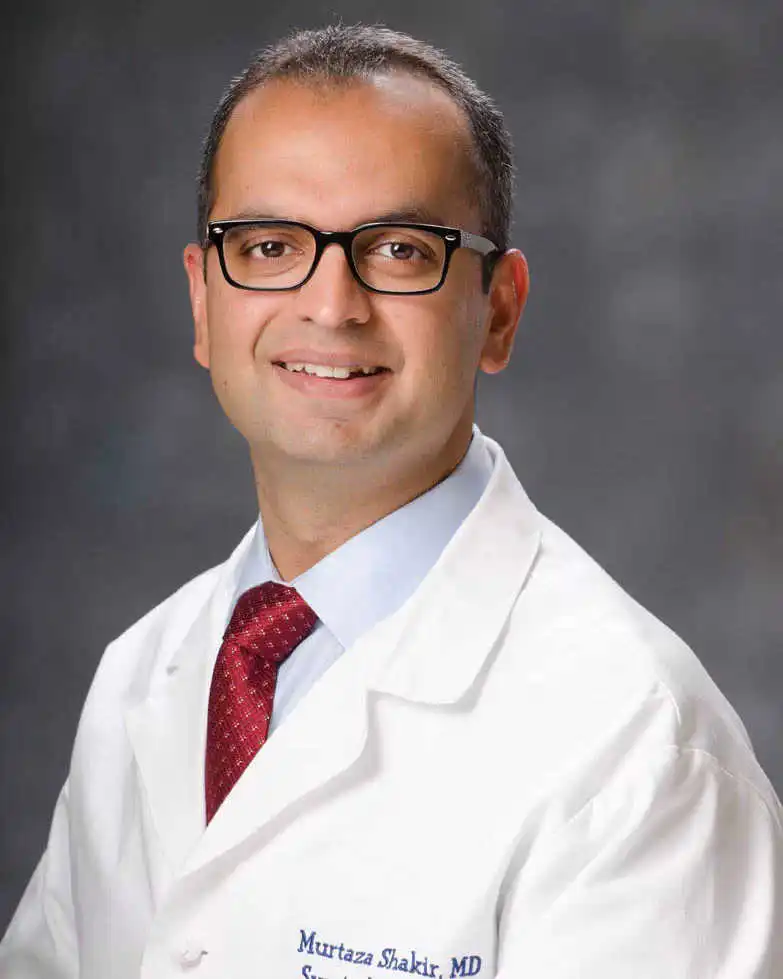
Meet the Surgeon
Dr. Murtaza Shakir, MD, general surgeon and surgical oncologist seeing Houston patients in Katy and Sugar Land, TX
- Dual board certified in General Surgery and Complex General Surgical Oncology
- Named a Houstonia Top Doctor in General Surgery, 2026 (see listing)
- Highly reviewed: rated 4.9 stars on Google
- Specialized in hernia repair, gallbladder removal, appendectomy, reflux surgery, skin lesion removal, wound care and cancer surgery using open, laparoscopic and robotic approaches
Patient Reviews
What Patients Say About Dr. Shakir
Rated 4.9 stars on Google. Real experiences from patients treated in Katy and Sugar Land.
Jump to a section
- At a glance
- Where Houston patients are seen
- What a general surgeon treats
- Surgical services
- When to see a surgeon
- Surgeon or emergency room?
- Does it need surgery?
- Meet your surgeon
- Your first consultation
- Open, laparoscopic or robotic
- Surgery day and recovery
- Houston areas served
- Insurance and referrals
- Patient reviews
- Why choose us
- Insurance
- Locations
- FAQs
- Schedule a consultation
At a Glance
Houston General Surgery at a Glance
- Where you are seen
- There is no office inside Houston city limits. Houston patients are seen in Katy (410 W Grand Pkwy S, Suite 4D, Katy, TX 77494) or Sugar Land (17510 W Grand Pkwy S, Suite 320, Sugar Land, TX 77479).
- Hours and phone
- Both offices: Monday to Friday, 9:00 AM to 5:00 PM. One number for both: 713-955-9191.
- Your surgeon
- Dr. Murtaza Shakir, MD, board certified in General Surgery and Complex General Surgical Oncology. He sees patients at both offices.
- Conditions treated
- Hernias, gallstones and gallbladder disease, appendicitis, acid reflux and hiatal hernia, hemorrhoids, skin lesions and cysts, slow-healing wounds, and breast, colon, liver, pancreatic and thyroid cancers.
- Surgical approaches
- Open, laparoscopic and robotic surgery, chosen for your condition, your health and any previous operations.
- Houston areas served
- West Houston, the Energy Corridor, Memorial, Westchase, Alief, southwest Houston and the rest of Greater Houston.
- Getting started
- A referral from your doctor or an emergency room, or a call to our office. Some insurance plans require a referral.
- Go to the ER for
- Severe or worsening abdominal pain, a hernia bulge that is hard, discolored and will not go back in, fever with belly pain, yellow skin or eyes, or vomiting that will not stop. Call 911 or go to the nearest emergency department.
Our Offices
Where Do Houston Patients See Dr. Shakir?
Houston patients see Dr. Shakir at our Katy or Sugar Land office, because Surgical Associates of Southern Texas does not have an office inside the city of Houston. Both offices are on the Grand Parkway. Each offers the same surgeon and the same services, so the choice is yours.
Most patients pick the office that is easier to reach from home or work. Some simply take the first available appointment. Your consultation, any pre-operative visit and your follow-up can stay at the office you choose.
Katy Office
410 W Grand Pkwy S, Suite 4D
Katy, TX 77494
Often the more convenient choice for patients from West Houston, the Energy Corridor and Memorial, as well as Cinco Ranch, Fulshear, Cypress and Sealy.
Monday to Friday, 9:00 AM to 5:00 PM
713-955-9191
Sugar Land Office
17510 W Grand Pkwy S, Suite 320
Sugar Land, TX 77479
Often the more convenient choice for patients from southwest Houston, as well as Missouri City, Stafford, Richmond, Rosenberg, Sienna and Riverstone.
Monday to Friday, 9:00 AM to 5:00 PM
713-955-9191
Live farther out? We also have pages for patients in Fulshear and Richmond, or see all locations.
The Specialty
What Does a General Surgeon Treat?
A general surgeon diagnoses and operates on conditions of the abdomen, abdominal wall, digestive organs, skin and soft tissue. The American Board of Surgery describes the specialty as centered on diseases of the abdomen, with training that also covers the digestive tract, breast, skin and soft tissue, and endocrine glands.
For most Houston-area patients, that means hernias, gallbladder problems and appendicitis. It also includes reflux that medicine no longer controls, hemorrhoids, and lumps, cysts or skin lesions that may need removal. The word general describes the breadth of training, not a lack of focus.
General Surgery and Cancer Surgery
Dr. Shakir is also board certified in Complex General Surgical Oncology, a specialty focused on the surgical treatment of cancer, including rare and complex cancers. That training lets him provide surgical care for selected breast, colon and rectal, liver, pancreatic and thyroid cancers, working with your oncology team. Learn more about surgical oncology and what a surgical oncologist does.
Our Services
Which Surgical Services Can Houston Patients Get?
Houston patients have access to every service the practice offers, at either office. Each card below is a short summary that links to a page with symptoms, treatment options and recovery details.
Hernia Repair
Repair of inguinal, umbilical, ventral, incisional and recurrent hernias with open, laparoscopic or robotic surgery. Read about hernia repair or our hernia surgeon page for Houston patients.
Gallbladder Surgery
Evaluation of gallstones and gallbladder attacks, and gallbladder removal (cholecystectomy), usually laparoscopic. Read about gallbladder surgery or our gallbladder surgeon page for Houston patients.
Appendicitis
Inflammation of the appendix, usually treated by removing it (appendectomy). Suspected appendicitis needs emergency care first. Read about appendicitis and appendix removal.
Reflux and Hiatal Hernia
Laparoscopic antireflux surgery for reflux (GERD) or hiatal hernia that medicine and lifestyle changes have not controlled. Read about reflux surgery.
Hemorrhoids
Care for bleeding, painful or bulging hemorrhoids, from home treatment to office procedures and surgery when needed. Read about hemorrhoid treatment.
Skin Lesions, Lipomas and Cysts
Evaluation and removal of skin lesions, lipomas, cysts and other lumps, with a biopsy when cancer is a concern. Read about skin lesion, mass and cyst removal.
Wound Care
Care for chronic and slow-healing wounds, including diabetic and venous ulcers and surgical wounds that are not healing as expected. Read about wound care.
Surgical Oncology
Surgical evaluation and treatment of cancer, coordinated with your other cancer doctors. Read about surgical oncology.
Cancer Surgery by Type
Signs and Referrals
When Should You See a General Surgeon?
You should see a general surgeon when a symptom or test result points to a problem that may need an operation, or when another doctor asks for a surgical opinion. Most patients arrive by one of two routes: they already have a diagnosis, or they have symptoms that keep coming back.
You Have a Diagnosis in Hand
- An emergency room visit found gallstones or an inflamed gallbladder
- A CT scan or ultrasound showed a hernia
- Your primary care doctor or gastroenterologist referred you for a surgical opinion
- Imaging found a mass or lesion that may need to be removed
- A biopsy confirmed a cancer that may be treated with surgery
You Have Symptoms That Keep Returning
- A bulge in the groin or near the belly button, with or without pain
- Upper right abdominal pain after meals, sometimes spreading to the back or shoulder
- Pain or pressure when you lift, cough or strain
- Heartburn or regurgitation that continues despite medicine
- Rectal bleeding, itching or a lump near the anus
- A lump under the skin that is growing or bothering you
- A wound that has not healed after several weeks
Not sure whether your symptom needs a surgeon? These guides may help: should I see a surgeon for hernia pain?, gallbladder attack symptoms and choosing the right general surgeon.
Know Where to Go
General Surgeon Office or Emergency Room?
A planned office visit suits problems that have built up over weeks or months; sudden, severe symptoms belong in an emergency room. A hernia that aches with activity, gallstones found on a scan, or a slowly growing lump can wait for a consultation. Call 713-955-9191 to book one in Katy or Sugar Land.
Our offices are surgical clinics, not emergency facilities. If you were treated in a Houston emergency room and told to follow up with a surgeon, call us after discharge and bring your paperwork. Read more about what happens after the ER finds gallstones.
Do Not Wait for an Appointment If You Have
Do not wait for an appointment if you have severe or worsening belly pain, pain moving to the lower right abdomen, a hard hernia bulge that will not go back in, fever, yellow skin or eyes, or blood in vomit or stool. For a medical emergency, call 911 or go to the nearest emergency department.
Surgery or Not
Does Seeing a Surgeon Mean You Need an Operation?
No. A first visit with Dr. Shakir is an evaluation, not a commitment to surgery. Many conditions are first managed with medicine, lifestyle changes or careful monitoring. An operation is recommended when its expected benefit outweighs its risks for you.
- Hernias: adult hernias do not heal on their own, but some small hernias that cause few symptoms can be watched.
- Gallstones: gallstones found by chance that cause no symptoms often need no treatment. Gallstones that cause attacks, inflammation or pancreatitis usually do.
- Reflux: most people with GERD improve with lifestyle changes and medicine; surgery is considered when those do not work.
- Hemorrhoids: many flare-ups settle with fiber, fluids and simple treatments.
- Skin lumps: many are harmless and can be watched, while changing or suspicious lesions are removed or biopsied.
A Scan Found Something. What Now?
Hernias, gallstones and small masses are often found on a CT scan or ultrasound done for another reason. Bring the report, and the disc if you have one, to your visit. Dr. Shakir compares the findings with your symptoms and explains whether treatment is needed now, later or not at all. See a CT scan showed a hernia and do gallstones always need surgery?
Your Surgeon
Meet Your General Surgeon
Murtaza Shakir, MD
Board-Certified General Surgeon & Surgical Oncologist
General surgery for Houston patients at Surgical Associates of Southern Texas is led by Dr. Murtaza Shakir, who is board certified in General Surgery and Complex General Surgical Oncology.
Board certification
American Board of Surgery: General Surgery and Complex General Surgical Oncology
Medical degree
Aga Khan University
Residency
General Surgery, Riverside Methodist Hospital, Columbus, Ohio
Fellowship
Two-year Surgical Oncology fellowship, University of Pittsburgh Medical Center
Surgical practice includes
- Hernia repair
- Robotic surgery
- Laparoscopic surgery
- Complex abdominal surgery
- Gallbladder surgery
- Surgical oncology
Named a Houstonia Top Doctor in General Surgery (2026). Learn more about our general surgery services.
What to Expect
What Happens at Your First Consultation?
Your first visit answers three questions: what is causing the problem, whether surgery will help, and what the options involve. The visit follows the same steps at either office.
What to Bring
- Photo ID and your insurance card
- A referral, if your plan requires one
- Reports or discs from any CT scan, ultrasound or MRI, including ER imaging
- Biopsy, endoscopy or colonoscopy reports, if you have them
- A list of your medicines, especially blood thinners
- Operative reports from any earlier surgery
- Questions you want answered before deciding
You can complete patient forms before you arrive. Second-opinion visits are welcome too.
History and Exam
Dr. Shakir asks about your symptoms, health history, medicines and past operations, then examines you.
Review of Your Records
He reviews any imaging, lab results, endoscopy or biopsy reports, including records from Houston hospitals and emergency rooms. More tests are ordered only when needed.
A Clear Plan
You learn whether an operation is recommended now, later or not at all, which approach fits and what recovery is likely to involve.
Surgical Approaches
Open, Laparoscopic or Robotic: How Is the Approach Chosen?
No single technique is best for every patient. Dr. Shakir performs all three and recommends the one that fits your condition, anatomy, previous surgery and overall health, rather than defaulting to one method.
Is Robotic Surgery Always Better?
No. Laparoscopic and robotic surgery share many of the same advantages over open surgery, such as smaller incisions and, for many patients, less pain. The best approach is the one that lets the operation be done safely and well for your situation. Compare them in robotic vs laparoscopic gallbladder surgery and robotic vs open hernia repair.
Changing to an Open Operation
Sometimes a minimally invasive operation is changed to an open one because of scar tissue, inflammation, bleeding or unclear anatomy. This is a safety decision, and it is discussed with you before surgery.
| Feature | Open | Laparoscopic | Robotic |
|---|---|---|---|
| Incisions | One incision over the problem area | Several small incisions | Minimally invasive, small incisions |
| Instruments | Through one incision | Thin camera and narrow instruments | Wristed instruments, console with 3-D view |
| Common uses | Some small hernias, emergencies, cancer operations | Gallbladder, groin hernias, appendix, reflux | Ventral, incisional and recurrent hernias |
| Recovery | Usually longer | Often outpatient, same day | Often outpatient, same day |
Typical patterns only. Dr. Shakir recommends an approach after your exam.
After Your Visit
Where Is Surgery Done, and What Is Recovery Like?
Where your procedure happens and how long recovery takes depend on the operation. Our staff tells you the location and what to expect before surgery day. Clinic visits before and after surgery stay in Katy or Sugar Land.
Preparing and Healing
After many laparoscopic and robotic operations, people return to light daily activity within days. Open and larger operations take longer, and Dr. Shakir gives you written instructions for your procedure. Our pre-operative care, post-operative care and Enhanced Recovery After Surgery (ERAS) pages explain what to do before and after.
Call the office for fever, spreading redness or drainage at an incision, or pain your medicine does not control.
In the Office
Smaller procedures, such as removing many skin lesions and cysts, can often be done in the office with local anesthesia. You go home right afterward.
Outpatient Surgery
Many minimally invasive operations, including most planned gallbladder removals and many hernia repairs, are outpatient. Many patients go home the same day.
Hospital Stay
Larger or urgent operations, such as cancer surgery, complex hernia repair or surgery for a ruptured appendix, may need a stay of one or more days.
Areas Served
General Surgery for West and Southwest Houston
Many of our Houston patients live or work on the west and southwest sides of the city. The areas below are service areas, not separate offices; every visit takes place in Katy or Sugar Land. Patients from other parts of Greater Houston are welcome too.
West Houston and the Energy Corridor
Patients from West Houston and the Energy Corridor often choose the Katy office. The Sugar Land office is available if its schedule suits you better.
Memorial
Memorial-area patients can be seen at either office. Many find the Katy office the simpler choice.
Westchase and Alief
Patients from Westchase and Alief can use Katy or Sugar Land. Choose the office that fits your commute or the first available appointment.
Southwest Houston
Patients from southwest Houston often choose the Sugar Land office, which also serves Missouri City and Stafford.
Looking for one condition? See our hernia surgeon and gallbladder surgeon pages for Houston patients.
Coverage Questions
Insurance and Referrals for Houston Patients
We accept many major insurance plans, including participating Aetna, Blue Cross Blue Shield, Cigna and UnitedHealthcare plans. Coverage depends on your specific plan, so our staff verifies your benefits and handles any authorization your plan requires before surgery. Some plans, often HMO plans, require a referral from your primary care doctor before a surgical visit.
Carrier details: Aetna, Blue Cross Blue Shield, Cigna and UnitedHealthcare. For other plans, see our insurance page.
Why Choose Us
Why Houston Patients Choose Surgical Associates of Southern Texas
Dr. Murtaza Shakir is board certified in General Surgery and Complex General Surgical Oncology and sees Houston patients at two offices just west of the city.
- One surgeon for hernias, gallbladder, reflux, skin lumps and more
- Open, laparoscopic and robotic surgery, matched to your condition
- Diagnosis and operation explained clearly before surgery
- The same surgeon at either office
- Consultations in Katy and Sugar Land
Insurance Coverage
Insurance for General Surgery
Surgical Associates of Southern Texas accepts many major insurance plans for general surgery consultations and procedures, including participating Aetna, Cigna, UnitedHealthcare, and Blue Cross Blue Shield plans. Our office can confirm whether your specific plan participates and whether a referral or prior authorization is needed before your visit.
Coverage, network participation, authorization requirements, and your share of the cost vary by plan. You can also review the insurance accepted for surgical care at our practice.
Aetna, Cigna, UnitedHealthcare, and Blue Cross Blue Shield are only some of the plans we accept. Plan-specific details are on our Aetna, Cigna, UnitedHealthcare, and Blue Cross Blue Shield pages. If your plan is not listed, contact our office and our team will help verify it.
Insurance participation and benefits vary by individual plan. Verification does not guarantee coverage, authorization or payment. Please contact our office and your insurer to verify benefits before treatment.
Our Locations
Two Convenient Fort Bend County Offices
Learn more about our Katy and Sugar Land practices, or view all locations.
Katy Office
410 W Grand Pkwy S, Suite 4D
Katy, TX 77494
Serves: Katy, Fulshear, Richmond, Cinco Ranch and West Houston
Sugar Land Office
17510 W Grand Pkwy S, Suite 320
Sugar Land, TX 77479
Serves: Sugar Land, Richmond, Stafford, Missouri City, Fort Bend County and Southwest Houston
Approximate Drive Times
From West Houston (Energy Corridor): about 15 minutes to Katy, or 25 to 30 minutes to Sugar Land.
From North Houston: about 40 to 50 minutes to either office, depending on traffic.
Common Questions
Frequently Asked Questions From Houston Patients
Is there a general surgeon office in Houston?
No. Surgical Associates of Southern Texas does not have an office inside Houston city limits. Houston patients see Dr. Murtaza Shakir at the Katy office (410 W Grand Pkwy S, Suite 4D) or the Sugar Land office (17510 W Grand Pkwy S, Suite 320).
What does a general surgeon treat?
A general surgeon treats conditions of the abdomen, digestive organs, abdominal wall, skin and soft tissue. Common examples are hernias, gallbladder disease, appendicitis, reflux, hemorrhoids and skin lumps. Dr. Shakir also provides surgical care for several cancers.
What kind of doctor should I see for a hernia?
A general surgeon evaluates and repairs hernias. Your primary care doctor may find a hernia first, but repair is surgical, so a general surgeon decides whether and how it should be fixed. See our hernia surgeon page for Houston patients.
Which doctor removes a gallbladder?
A general surgeon removes the gallbladder, an operation called cholecystectomy. Most planned removals are done laparoscopically, with robotic surgery used in selected cases. See our gallbladder surgeon page for Houston patients.
I went to the ER and they found gallstones. What happens next?
The usual next step is an appointment with a general surgeon. Bring your ER paperwork and imaging reports so Dr. Shakir can decide whether the gallstones are causing your symptoms. Return to the ER for fever, yellow skin or eyes, or pain that does not settle. Read what happens after the ER finds gallstones.
A CT scan showed a hernia. Do I need surgery?
Not always. Small hernias that cause no symptoms can sometimes be watched, while painful or growing hernias usually warrant repair. Read more in a CT scan showed a hernia.
Should I go to the ER or see a surgeon for belly pain?
Go to the ER for sudden, severe or worsening abdominal pain, especially with fever, vomiting, a rigid belly or a hard hernia bulge. Pain that comes and goes over weeks, such as after meals, is usually best checked at a scheduled visit.
Is robotic surgery better than laparoscopic surgery?
Not automatically. Robotic surgery can help with certain ventral, incisional and recurrent hernias, while laparoscopic surgery works well for most gallbladder removals. Dr. Shakir recommends the approach that suits your condition.
Do I need a referral to see Dr. Shakir?
It depends on your insurance. Many patients are referred by a primary care doctor or an emergency room, but some plans, often HMO plans, require a referral. Our staff can help you check. See our insurance information.
Which insurance plans do you accept?
The practice accepts many major plans, including participating Aetna, Blue Cross Blue Shield, Cigna and UnitedHealthcare plans. Coverage varies by plan, so please verify your benefits before surgery.
Sources and references
- Specialty Definitions: General Surgery and Complex General Surgical Oncology, American Board of Surgery (ABS)
- Surgeon Qualifications and Certifications, American College of Surgeons (ACS)
- Healthy Sooner: Patient Information for Minimally Invasive Surgery, Society of American Gastrointestinal and Endoscopic Surgeons (SAGES)
- Abdominal Pain, MedlinePlus, U.S. National Library of Medicine
- When to Use the Emergency Room: Adult, MedlinePlus, U.S. National Library of Medicine
Reviewed by the Review Team at Surgical Associates of Southern Texas.
Medical Disclaimer: This page provides general information and is not a substitute for medical advice. For severe or worsening abdominal pain, a hernia that is hard or discolored and will not go back in, heavy bleeding, or other emergencies, call 911 or go to the nearest emergency room. Last updated October 16, 2026.
Schedule a General Surgery Consultation
Houston patients from West Houston, the Energy Corridor, Memorial, Westchase, Alief and Southwest Houston can meet Dr. Murtaza Shakir at our Katy or Sugar Land office about a pain, bulge, lump or scan finding. New patients are welcome. Call 713-955-9191 or request a consultation online.

Contact us now