 EN
EN ES
ES UR
UR HI
HI
Groin bulge or aching that won’t settle?
Have it checked by board-certified general surgeon Dr. Murtaza Shakir in Katy or Sugar Land. Call (713) 955-9191, or send your details and our team will call you back.
THE SHORT ANSWER
Robotic inguinal hernia repair fixes a groin hernia through three or four small incisions, placing a sheet of mesh behind the abdominal wall where abdominal pressure holds it flat. It works much like laparoscopic repair for a simple one-sided hernia and is especially useful for hernias on both sides or a hernia that came back after open repair. Most people return to desk work in about a week.
What Is an Inguinal Hernia?
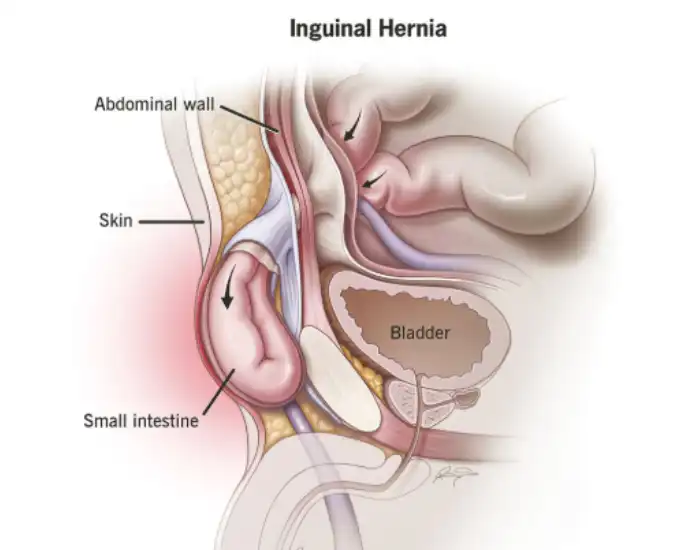
An inguinal hernia is a bulge of fat or intestine that pushes through the inguinal canal, a natural weak point in the lower abdominal wall on each side of the groin. In men the canal carries the spermatic cord to the testicle; in women it carries the round ligament of the uterus. The hernia usually causes a bulge or an ache in the groin that is worse with standing, lifting or coughing.
Direct, indirect and femoral hernias
- Indirect: enters the canal through its internal opening and can follow the cord toward the scrotum. It is often present from birth and is the most common type in younger men.
- Direct: pushes through a weakened area of the canal floor and is more typical in older adults after years of strain.
- Femoral: sits just below the groin crease and is more common in women.
The distinction matters less with a robotic repair than with an open one, because mesh placed behind the abdominal wall covers all three potential sites at once.
One side or both
A hernia on one side is unilateral; on both sides, bilateral. Some patients have a hernia on the other side without knowing it. Because the robotic approach views both groins from inside, a hidden hernia on the opposite side can be identified and, with your consent, repaired in the same operation.
When Does an Inguinal Hernia Need Repair, and When Is It an Emergency?
An inguinal hernia usually needs repair when it causes symptoms, and it needs emergency care when it becomes trapped and painful. Symptoms that commonly lead to repair include:
- A bulge in the groin, more obvious when standing or straining, that often flattens when lying down
- Aching, pulling, burning or pressure in the groin, especially by the end of the day
- Pain with lifting, coughing, sneezing or prolonged standing
- Discomfort spreading to the inner thigh or, in men, the testicle
- A bulge that has grown or has become harder to push back in
Men with a hernia that causes few or no symptoms may be able to wait safely with regular checkups, although international guidelines note that most will eventually need surgery. See inguinal hernia symptoms and hernia pain without a visible bulge.
Seek emergency care for sudden severe groin pain, a firm, tender or discolored (red, purple or dark) bulge that will not go back in, nausea and vomiting, fever, or inability to pass gas or stool. These suggest an incarcerated or strangulated hernia, which is life-threatening and needs immediate surgery.
How Is Robotic Inguinal Hernia Repair Performed?
The operation is a robotic transabdominal preperitoneal (TAPP) repair done under general anesthesia. The steps are:
- Three or four incisions of about 8 to 12 mm are made near the navel and lower abdomen, and the abdomen is gently inflated with carbon dioxide.
- A 3D camera and wristed instruments are placed through the ports. Dr. Shakir docks the robotic arms and controls every movement from a console in the operating room.
- The thin inner lining of the abdomen (peritoneum) is opened over the groin, and the hernia sac is freed and returned to the abdomen. Both groins are inspected.
- A flat sheet of mesh, typically about 10 by 15 cm, is positioned behind the abdominal wall, covering the direct, indirect and femoral hernia sites.
- The mesh is secured and the peritoneum is closed over it with sutures, so the mesh does not contact the intestine.
- If a hernia is present on the other side, the same steps are repeated through the same incisions.
- The gas is released and the incisions are closed with absorbable sutures and skin glue.
A one-sided repair usually takes about 45 to 90 minutes, and a bilateral repair somewhat longer. Most patients go home two to four hours after surgery. The surgeon performs the entire operation; nothing is automated.
Does Robotic Inguinal Hernia Repair Use Mesh?
Yes. International guidelines recommend mesh repair as the first choice for adult inguinal hernias, because mesh substantially lowers recurrence compared with a suture-only repair.
In the robotic approach the mesh sits in the preperitoneal space behind the abdominal wall, held flat by pressure from inside the abdomen, and is usually fixed with a few sutures or absorbable tacks. Over the following weeks the body’s tissue grows into the mesh, which is what makes the repair durable. The mesh is permanent and, once incorporated, is not normally felt; some patients notice a firm area for a few weeks that softens over time. Dr. Shakir discusses mesh type and fixation at your consultation.
Is Robotic Repair Better Than Laparoscopic or Open Repair?
For a straightforward one-sided inguinal hernia, robotic and laparoscopic repair give comparable results. A multicenter randomized trial (RIVAL) found no clinical benefit of robotic over laparoscopic inguinal repair, along with longer operating times and higher device-related costs in the robotic group. Both approaches are minimally invasive, both place mesh behind the abdominal wall and both have similar recovery.
Surgeons tend to favor the robotic platform’s wristed instruments and 3D view for:
- Hernias on both sides
- Recurrent hernias after a previous open repair
- Large hernias that extend into the scrotum
- Patients with a higher body-mass index or prior lower abdominal surgery
Open repair remains appropriate for many patients. Dr. Shakir performs robotic, laparoscopic and open repair and will say plainly which fits you. See robotic vs. open hernia repair.
Wondering Which Repair Fits You?
Dr. Murtaza Shakir performs robotic, laparoscopic and open inguinal hernia repair and can recommend the right approach at a consultation in Katy or Sugar Land.
Can Robotic Repair Fix Both Sides or a Hernia That Came Back?
Yes, and these are two of the situations where robotic repair is most useful.
Bilateral hernias
When hernias are present on both sides, robotic repair treats both through the same three or four incisions in one operation, with mesh placed on each side. There is one anesthetic, one recovery and no second set of incisions, which is a practical advantage over open repair, which would need an incision in each groin. Recovery after a bilateral repair is usually only modestly longer than after a one-sided repair.
Recurrence after a previous open repair
A patient who had an open groin repair years ago and now has a recurrence can usually be treated robotically. The robotic approach reaches the groin from inside, through a plane the earlier operation never entered, so the scar tissue and old mesh at the front are avoided. The reverse is also true: after a failed laparoscopic or robotic repair, an open repair from the front is usually preferred. Bring prior operative reports if you have them. Learn more about recurrent hernia repair.
How Painful Is Robotic Inguinal Hernia Repair?
Most patients have moderate soreness at the incisions and a bruised feeling in the lower abdomen for three to five days, controlled with acetaminophen and ibuprofen; a short course of stronger medication is provided if needed. Other common, temporary effects include:
- Shoulder-tip discomfort from the gas used during surgery for a day or two
- Mild swelling or bruising of the groin or scrotum that settles over one to two weeks
Some patients have less early discomfort than after an open repair, but pain varies widely and is not guaranteed to be lower with any technique. Groin pain that lasts beyond three months should be reported. International guidelines estimate clinically significant long-term pain after groin hernia repair, by any method, at roughly 10 to 12 percent, decreasing over time, with severe, disabling pain much less common.
What Is the Recovery Timeline After Robotic Inguinal Hernia Repair?
Most people go home the same day, return to desk work in about a week and are cleared for heavier lifting at four to six weeks.
- Day of surgery: home within a few hours with a driver. Walk short distances that evening; it eases gas discomfort and lowers clot risk.
- Days 1 to 3: soreness improves daily. Shower after 24 to 48 hours and keep the incisions clean and dry. Eat small meals and drink plenty of fluids; a stool softener helps if pain medication causes constipation.
- Week 1: light daily activity, stairs and short walks are fine.
- Weeks 2 to 4: energy returns to normal. Light cardio such as a stationary bike is often reasonable at two weeks.
- Weeks 4 to 6: heavier lifting and core exercise are typically cleared once the mesh has incorporated. Running and weight training are eased back in gradually.
| Activity | Typical timing |
|---|---|
| Desk work | Often within about one week |
| Driving | Three to five days, once off narcotic medication and able to brake comfortably |
| Physical work | Usually two to four weeks; a work note with lifting limits is provided |
| Lifting over about 15 pounds | Avoid until four to six weeks |
| Running, weights, core work | Four to six weeks |
| Sexual activity | When comfortable, typically one to two weeks |
Symptoms to report during recovery
- Fever over 101°F or chills
- Redness, warmth, swelling or drainage at an incision
- Pain that worsens after the third day rather than improving
- Marked swelling of the groin or scrotum, or a new bulge
- Difficulty urinating, or no bowel movement two to three days after surgery
- Persistent nausea, vomiting, or inability to pass gas or stool
- Calf pain or swelling, chest pain or shortness of breath: call 911
These are typical ranges; recovery varies with age, fitness, whether one or both sides were repaired and how the operation went. Follow our post-operative care guide and see how long hernia surgery recovery takes.
Who Performs Robotic Inguinal Hernia Repair in Katy and Sugar Land?
Dr. Murtaza Shakir, a board-certified General Surgeon who is also board certified in Complex General Surgical Oncology, performs robotic, laparoscopic and open inguinal hernia repair at Surgical Associates of Southern Texas. He selects the approach based on anatomy, hernia type, previous surgery and individual patient factors.
- Katy: 410 W Grand Pkwy S, Suite 4D, Katy, TX 77494
- Sugar Land: 17510 W Grand Pkwy S, Suite 320, Sugar Land, TX 77479
Consultations and follow-up visits serve patients from Richmond, Fulshear, Cinco Ranch, Missouri City, Stafford and West Houston. Meet Dr. Shakir, read the broader inguinal hernia repair and robotic hernia repair pages, see the Katy or Sugar Land hernia pages, or request a consultation by calling (713) 955-9191.
Questions to Ask Your Surgeon About Robotic Inguinal Hernia Repair
- Is my hernia direct, indirect or femoral, and is there one on the other side?
- Do you recommend robotic, laparoscopic or open repair for me, and why?
- What type of mesh will you use, and how will it be fixed?
- If you find a hernia on the other side during surgery, will you repair it?
- When can I return to work, drive and lift?
- Which symptoms after surgery should make me call the office or go to the ER?
Frequently Asked Questions
Can an inguinal hernia be repaired robotically?
Yes. Robotic TAPP repair is a standard minimally invasive option for inguinal hernias, placing mesh behind the abdominal wall through three or four small incisions.
How long does robotic inguinal hernia surgery take?
About 45 to 90 minutes for one side, and longer for both. Plan on most of a day at the surgical center, including check-in and recovery.
When can I go back to work after robotic inguinal hernia repair?
Desk work is often possible within about a week, and physical work in two to four weeks with lifting limits. See time off work after hernia surgery.
Can both sides be repaired at the same time?
Yes. A bilateral robotic repair uses the same incisions and adds only modestly to recovery time.
Will I be able to feel the mesh?
Once incorporated, the mesh is not normally felt. Some patients notice a firm area for a few weeks that softens over time.
Can I have robotic repair if my first hernia repair was open?
Usually, yes. The robotic approach avoids the scarred plane of the earlier operation and is often the preferred way to repair a recurrence after open surgery.
Key Takeaway
Robotic inguinal hernia repair places mesh behind the abdominal wall through small incisions and is especially useful for hernias on both sides and for recurrences after open repair. For a simple one-sided hernia it performs comparably to laparoscopic repair, and open repair remains appropriate for many patients. Recovery is typically about a week to desk work and four to six weeks to full lifting.
Sources and Further Reading
- International Guidelines for Groin Hernia Management, HerniaSurge Group, Hernia (2018), via PubMed Central
- Inguinal and Femoral Groin Hernia Repair, American College of Surgeons Patient Education
- Inguinal Hernia, National Institute of Diabetes and Digestive and Kidney Diseases (NIDDK)
- Is Robotic-Assisted Surgery a Step in the Right Direction for Routine Inguinal Hernia Repair? (commentary on the RIVAL trial), Laparoscopic Surgery (2022)
This article is general education, not personal medical advice. For a hernia that becomes hard, very painful or discolored and will not go back in, or for severe abdominal pain with vomiting, call 911 or go to the nearest emergency room.

Meet the Surgeon
Dr. Murtaza Shakir is a board-certified General Surgeon and is board certified in Complex General Surgical Oncology. He earned his medical degree at Aga Khan University, completed General Surgery residency at Riverside Methodist Hospital in Columbus, Ohio, and a two-year Surgical Oncology fellowship at the University of Pittsburgh Medical Center. He sees patients at Surgical Associates of Southern Texas in Katy and Sugar Land.
Related Reading and Care
Schedule a Hernia Evaluation
Find out whether robotic, laparoscopic or open repair fits your groin hernia at our Katy or Sugar Land office.
This page provides general information and is not a substitute for medical advice. For severe abdominal pain or other emergencies, call 911 or go to the nearest emergency room. Last updated October 16, 2026.