 EN
 ES
 UR
 HI


Quick clinical overview
A hernia is tissue pushing through a weak spot or tear in the abdominal wall. It is caused by pressure inside the abdomen meeting a weak area of muscle or fascia. Surgery is the only permanent repair, and modern techniques reinforce the defect with tension-free mesh. The main danger is strangulation, when trapped tissue loses its blood supply.
Hernias at a glance
- What a hernia isAn organ or fatty tissue pushing through a weakened area or tear in the surrounding muscle or connective tissue (fascia).
- Why it happensIncreased pressure inside the abdomen from lifting, coughing, or straining, combined with a pre-existing weak spot in the wall.
- The definitive cureSurgery is the only permanent fix. Modern repairs reinforce the defect with tension-free mesh or a specialized tissue repair.
- The primary dangerStrangulation: trapped tissue loses its blood supply, which is a life-threatening surgical emergency.
Part 1: Anatomy, types, and symptoms
1. What is an abdominal wall or groin hernia, and why do they develop?
A hernia occurs when an internal organ (most often a loop of small intestine) or abdominal fat pushes through a tear or opening in the fascia, the tough sheet of connective tissue that holds the abdominal muscles in place. Hernias come from a combination of muscle weakness, which may be present from birth, develop with age, or follow a previous operation, and sustained pressure inside the abdomen from heavy lifting, chronic coughing, obesity, constipation, or pregnancy.
Dr. Shakir repairs inguinal, umbilical, ventral, incisional, and recurrent hernias using open, laparoscopic, and robotic techniques. See our hernia repair page for details.
2. What are the most common types of hernias?
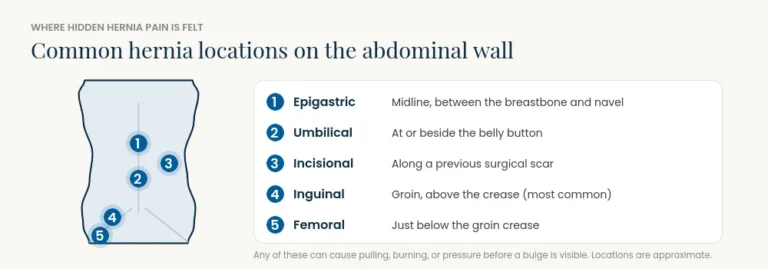
Most hernias develop in the abdominal wall and groin. Inguinal hernias in the groin crease make up about three quarters of all cases and are far more common in men. Umbilical, incisional, epigastric, femoral, and hiatal hernias make up most of the rest.
| Type | Where it is | Who gets it |
|---|---|---|
| Inguinal | Groin crease | About 75% of all hernias; much more common in men |
| Femoral | Just below the groin crease, near the femoral artery | Less common; higher strangulation risk; most often older women |
| Umbilical | At the belly button | Infants, and adults after pregnancy or weight gain |
| Incisional | Along the scar of a previous abdominal operation | Anyone with prior abdominal surgery |
| Epigastric | Midline between the navel and the lower ribs | Adults; often small and painless |
| Hiatal | Internal: upper stomach pushes up through the diaphragm | Causes reflux rather than an external bulge; see reflux surgery |
3. What does a hernia feel like?
Early on, most people notice a soft lump or swelling under the skin. Common sensations include a dull ache, a feeling of fullness, or a burning or dragging feeling that gets worse after standing for a long time, bending, coughing, or lifting. In many cases the bulge flattens or disappears when you lie down.
4. Can a hernia be painless and still need treatment?
Yes. Many hernias are painless bulges, but no pain does not mean no risk. Even a symptom-free hernia is a permanent opening in the muscle wall that tends to enlarge over time as abdominal pressure keeps pushing against it.
5. What is the difference between a "reducible" and an "incarcerated" hernia?
A reducible hernia can be gently pushed back inside, or slides back on its own when you lie down. These are stable and are usually repaired with planned, elective surgery. An incarcerated hernia is stuck outside the abdominal wall and cannot be pushed back in. It needs urgent surgical assessment before complications develop.
6. What is a strangulated hernia, and why is it an emergency?
Strangulation happens when the muscular ring around the hernia opening clamps down on the trapped intestine or fat and cuts off its blood supply. Within hours the starved tissue can die, the bowel can perforate, and bacteria can spill into the bloodstream and cause sepsis. A strangulated hernia is a life-threatening emergency that requires an immediate operation.
Part 2: Non-surgical myths, belts, and watchful waiting
7. Can a hernia heal on its own or go away with abdominal exercises?
No. Muscle cannot grow across a structural tear in the fascia. Abdominal exercises such as sit-ups, planks, and crunches actually raise pressure inside the abdomen, which pushes more tissue through the defect and can make the hernia larger rather than closing it.
8. Do hernia trusses, support belts, or binders cure the problem?
Hernia belts and trusses apply outside pressure that can temporarily keep a bulge from protruding, but they do not heal or repair the opening. Worn for long periods, a tight truss can break down the skin, weaken the local muscles through disuse, and create false confidence while the defect underneath keeps growing.
9. Is "watchful waiting" acceptable for a hernia that has no symptoms?
For older adults or people with significant medical risks who have a small, completely symptom-free inguinal hernia, supervised watchful waiting is sometimes appropriate. That said, studies show up to 70 percent of patients who start with watchful waiting eventually have surgery within several years because symptoms progress or the hernia grows.
10. Can diet or lifestyle changes keep a hernia from getting worse?
Diet cannot close the tear, but a few changes reduce the pressure that pushes the hernia outward and can slow its growth while you plan repair.
- Keep bowel movements regular with more fiber and water so you are not straining.
- Treat a chronic cough promptly, and stop smoking.
- Avoid sudden, unassisted heavy lifting.
- Maintain a stable, healthy body weight to lower constant downward pressure on the abdominal wall.
Found a bulge in your groin or abdomen?
Dr. Murtaza Shakir repairs inguinal, umbilical, ventral, incisional, and recurrent hernias using open, laparoscopic, and robotic techniques in Katy and Sugar Land. Free consultations and same-week appointments are available.
Part 3: Surgical repair techniques (open, laparoscopic, robotic, and mesh)
11. What is the difference between open and laparoscopic or robotic hernia surgery?
In an open repair the surgeon makes one incision over the hernia, pushes the tissue back in, and repairs the defect with sutures and mesh from the outside, often under local anesthesia with sedation or general anesthesia. Laparoscopic and robotic repairs use three small puncture incisions (5 to 10 mm), a high-definition camera, and fine instruments to place the mesh behind the defect from inside the abdominal wall. The minimally invasive approach usually means less early pain and a faster return to normal activity, especially for hernias on both sides or recurrent groin hernias.
Dr. Shakir recommends the approach that best fits your hernia, anatomy, prior surgery, and overall health. Wondering about time off? Read how long you will be off work after hernia surgery.
12. Why is surgical mesh used in most hernia repairs?
Years ago, surgeons simply pulled the edges of the defect together and stitched them shut. That "primary tissue repair" put constant tension on the surrounding tissue, and recurrence rates ran 15 to 30 percent. Modern repairs use biocompatible mesh to create a tension-free bridge over the opening. The mesh acts as a scaffold your body grows its own collagen into, which lowers long-term recurrence to roughly 2 to 5 percent.
13. Is hernia mesh safe, and what are the main risks?
Synthetic mesh, usually medical-grade polypropylene or polyester, has been studied extensively and is considered the standard of care by major surgical societies. Complications are uncommon but can include chronic groin pain (about 2 to 5 percent of patients, from nerve irritation or scarring), surgical site infection, a seroma (fluid collection), or, very rarely, mesh migration.
14. Are there "mesh-free" surgical alternatives?
Yes. Specialized tissue repairs such as the Shouldice, Bassini, or Desarda techniques use layers of the patient's own tissue and permanent sutures without a synthetic implant. They are typically performed at dedicated specialty centers or chosen for patients with active infection, a mesh allergy, or a strong personal preference against implants, and they require considerable surgical expertise to keep tension and recurrence low.
Part 4: Recovery, heavy lifting, and long-term outcomes
15. How long does recovery take after hernia surgery?
Most people are back to light activity within a week or two after a minimally invasive repair and are cleared for heavy lifting and full exercise at four to six weeks, once the tissue has regained most of its strength.
Recovery milestones after hernia repair
- First 48 to 72 hoursMild to moderate soreness, swelling, and bruising around the incision, groin, or scrotum. Walk short distances several times a day.
- 1 to 2 weeksMost patients resume desk work, driving (once off narcotic pain medicine), and light walking after a minimally invasive repair.
- 4 to 6 weeksInternal tissue reaches roughly 80 to 90 percent of its final strength. Clearance for heavy lifting, sports, and physical labor usually comes at this point.
16. What are the lifting restrictions after hernia repair?
Surgeons typically limit lifting to 10 to 15 pounds, about the weight of a gallon of milk, for the first two to four weeks. Lifting or straining too early can disrupt the anchoring sutures before your own tissue has grown securely into the mesh.
17. Why do men get bruising or swelling in the scrotum after groin surgery?
Gravity pulls leftover blood and wound fluid down into the loose, low-pressure tissue of the scrotum, so purple bruising and swelling are very common after inguinal hernia repair. It can look alarming, but it is normal, peaks at three to five days, and reabsorbs over two to three weeks. Supportive underwear or an athletic supporter helps with comfort.
18. What causes chronic groin pain after hernia surgery, and how is it treated?
Groin pain lasting more than three months occurs in a small percentage of patients and is usually nerve-related, caused by irritation, stretching, or entrapment of the ilioinguinal, iliohypogastric, or genitofemoral nerves in scar tissue. Treatment steps up gradually: anti-inflammatory medicine, physical therapy, and diagnostic nerve blocks first, with surgical nerve release (neurectomy) reserved for persistent cases.
19. Can a hernia come back after it is repaired?
Yes, this is called a recurrent hernia. With modern mesh repair the rate is low, generally 1 to 5 percent, compared with older tension repairs. Common contributors are heavy lifting before full healing, smoking (which impairs collagen formation), a serious wound infection, and significant uncontrolled weight gain. Dr. Shakir has particular experience with recurrent hernia repair.
20. Which symptoms after hernia surgery indicate an emergency?
Contact your surgical team or go to the emergency room right away if you cannot urinate within six to eight hours after surgery, have a fever over 101°F (38.3°C) with chills, develop sudden, tense, rapidly growing or severe swelling at the surgical site, cannot keep fluids down, see spreading redness, heat, or foul-smelling drainage at an incision, or have chest pain, shortness of breath, or calf swelling and tenderness.
Red flags: signs of incarceration and strangulation
Go to the ER now
A hernia that was soft and easy to push back can become trapped at any time. Call 911 or go to the nearest emergency room immediately if you notice any of the following:
- A bulge that suddenly cannot be pushed back in and is firm, tender, or very painful
- Skin over the bulge turning red, purple, or dark
- Sudden severe abdominal or groin pain, especially with nausea or vomiting
- Bloating, inability to pass gas, or no bowel movement, which can mean a bowel blockage
- Fever, a racing heart, or feeling faint along with any of the above
Our offices are not emergency facilities. A strangulated hernia needs an operation within hours.
Key takeaways
- A hernia is a gap in the abdominal wall. It does not heal with rest, exercise, or a belt; surgery is the only permanent repair.
- Inguinal (groin) hernias are by far the most common type and occur mostly in men.
- A painless hernia still tends to grow and can become incarcerated or strangulated without warning.
- Tension-free mesh repair, open or minimally invasive, has cut recurrence rates to a few percent.
- Most patients are back to light activity in one to two weeks and fully cleared at four to six weeks.
Next steps
If you have noticed a bulge or have been told you have a hernia, an evaluation with a board-certified general surgeon will tell you whether it is safe to wait and which repair fits you best. Dr. Murtaza Shakir sees patients at our Katy and Sugar Land offices and performs open, laparoscopic, and robotic hernia repair. Call 713-955-9191 or request a free consultation online.