 EN
 ES
 UR
 HI

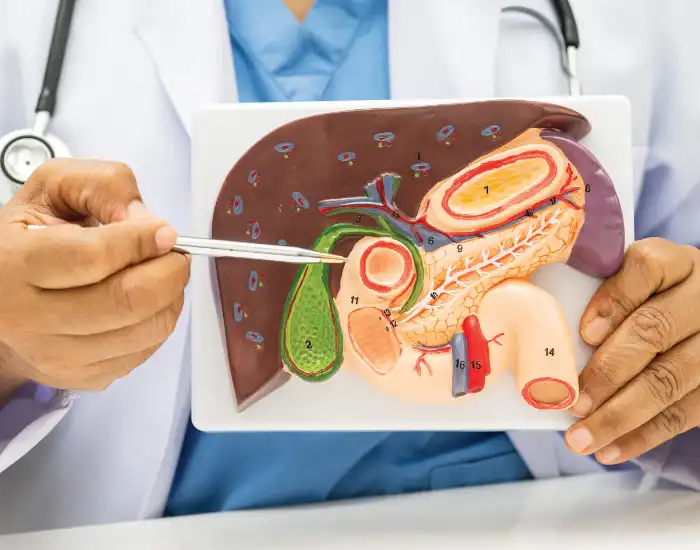
Gallbladder pain but a normal ultrasound?
Dr. Murtaza Shakir can review your tests in Katy or Sugar Land and discuss whether biliary dyskinesia fits your symptoms. Call (713) 955-9191, or send your details and our team will call you back.
THE SHORT ANSWER
Biliary dyskinesia is a functional gallbladder disorder: typical gallbladder-type pain without gallstones, usually with poor gallbladder emptying on a nuclear medicine test called a HIDA scan with cholecystokinin (CCK). After other causes of upper abdominal pain are ruled out, some patients benefit from gallbladder removal, but results are less predictable than surgery for gallstones, so careful evaluation matters.
What Is Biliary Dyskinesia?
Biliary dyskinesia is a condition in which the gallbladder muscle does not contract normally, so bile is not squeezed out the way it should be. Doctors also call it functional gallbladder disorder. It is less common and harder to diagnose than gallstones.
The gallbladder stores bile made by the liver and releases it into the intestine after you eat, especially after fatty foods. When it does not empty properly, the result can be recurring episodes of pain that feel just like a gallstone attack, even though no stones are present. The exact cause is usually unknown. Less often, the problem involves the sphincter of Oddi, the small muscle valve where the bile duct meets the intestine, which is evaluated separately in specialized centers.
What Are the Symptoms of Biliary Dyskinesia?
The symptoms of biliary dyskinesia look like a gallstone attack: episodes of steady pain in the upper abdomen that come and go. Typical features include:
- Episodes of steady pain in the upper right or upper middle abdomen, often lasting 30 minutes or longer
- Pain that may spread to the back or right shoulder blade
- Nausea, and sometimes vomiting, during episodes
- Episodes that recur and interfere with daily life, often after meals
The pattern matters as much as the location. Cleveland Clinic notes that diagnostic criteria look for episodes lasting at least 30 minutes that occur regularly over at least three months. Read more about gallbladder attack symptoms and gallbladder pain that spreads to the back or shoulder.
What Else Can Cause Gallbladder-Type Pain With a Normal Ultrasound?
Several other conditions can cause upper abdominal pain with a normal gallbladder ultrasound, which is why biliary dyskinesia is only diagnosed after they are considered. Clues that point away from the gallbladder include:
- Constant burning pain, or pain relieved by antacids: more typical of reflux or ulcers
- Symptoms that change with bowel movements: more typical of irritable bowel syndrome
Other gallbladder problems can also occur without stones, including gallbladder sludge, polyps and acalculous cholecystitis (an inflamed gallbladder without stones). Sorting these out is the first step. See gallbladder problems vs acid reflux and pain after eating in the upper abdomen.
How Is Biliary Dyskinesia Diagnosed?
Biliary dyskinesia is diagnosed largely by elimination: typical symptoms, no gallstones, no other explanation, and poor emptying on a HIDA scan. Evaluation commonly includes:
- An abdominal ultrasound to confirm there are no gallstones or sludge
- Blood tests, including liver tests and lipase
- An upper endoscopy in some patients, to look for ulcers or inflammation
- A HIDA scan with CCK, which measures how much of its contents the gallbladder empties, reported as the gallbladder ejection fraction
For the HIDA scan, a small amount of tracer is injected and tracked as it fills the gallbladder. CCK, a hormone that normally makes the gallbladder contract after meals, is then given through an IV. You are usually asked to fast for a few hours beforehand, because food can affect the result. Some patients notice pain during the CCK infusion that feels like their usual attacks.
A low ejection fraction together with typical symptoms and no other explanation supports the diagnosis. A low number alone, without typical pain, is not enough. Medications that slow the gallbladder can also lower the result, so bring a full medication list.
Gallbladder Pain but a Normal Ultrasound?
Dr. Murtaza Shakir can review your tests in Katy or Sugar Land and discuss whether biliary dyskinesia fits your symptoms.
How Do Surgeons Decide Whether Gallbladder Removal Will Help?
Surgeons recommend removal only when the whole picture fits, not on the HIDA number alone. Not everyone with a low ejection fraction improves after surgery, and false-positive results occur. Before recommending an operation, surgeons look for:
- Typical, recurrent biliary-type pain, not constant burning or bowel-related pain
- A thorough search for other causes, including ultrasound, blood tests and, when appropriate, endoscopy
- A HIDA scan showing poor emptying that matches the symptoms
- Symptoms that meaningfully affect quality of life, such as missed work or avoiding meals
When the picture is unclear, more testing is usually a better choice than surgery. A surgeon who is honest about uncertain cases helps you avoid an operation that may not relieve your pain.
Is Gallbladder Surgery the Treatment for Biliary Dyskinesia?
For carefully selected patients, laparoscopic gallbladder removal can relieve symptoms, and it is the main treatment when the diagnosis is clear. The operation is done through several small incisions, and patients often go home the same day.
Relief is less certain than after surgery for gallstones, which is why ruling out other causes first is so important. If pain continues after the gallbladder is removed, further evaluation may be needed. After surgery, many people digest more comfortably if they go easy on fried and fatty foods at first and add them back gradually. Learn about laparoscopic gallbladder removal, recovery after gallbladder removal and post-cholecystectomy syndrome.
When Is Gallbladder Pain an Emergency?
Biliary dyskinesia is not usually dangerous in the way an infected gallbladder or a blocked bile duct can be, but certain symptoms need urgent care no matter what the earlier tests showed. Go to the emergency room or call 911 for:
- Severe abdominal pain, or pain that lasts several hours
- Fever or chills with abdominal pain
- Yellowing of the skin or whites of the eyes
- Tea-colored urine or light-colored stools
- Persistent vomiting with abdominal pain
These signs suggest a different problem, such as infection, a blocked bile duct or pancreatitis, and should not be treated as another dyskinesia episode.
When Should I See a General Surgeon in Katy, Sugar Land or Houston?
See a general surgeon if you have repeated gallbladder-type attacks and your ultrasound was normal. A surgeon can review your testing, recommend whether a HIDA scan is appropriate, and help decide whether surgery is likely to help.
To make the visit useful, bring:
- Your ultrasound report and any CT scans
- Recent blood work, including liver tests and lipase
- Any endoscopy or HIDA scan results
- A list of medications and a short diary of when attacks happen
Dr. Murtaza Shakir sees patients from across the Houston area at offices in Katy and Sugar Land. Call (713) 955-9191 or request a consultation.
Questions to Ask Your Surgeon About Biliary Dyskinesia
- Do my symptoms fit typical gallbladder pain, or could another condition explain them?
- Have other causes, such as reflux or ulcers, been ruled out?
- Do I need a HIDA scan with CCK, and how should I prepare?
- What was my ejection fraction, and how does it fit with my symptoms?
- How likely is gallbladder removal to relieve my pain?
- What happens if my pain continues after surgery?
Frequently Asked Questions
Can you have gallbladder problems without gallstones?
Yes. Biliary dyskinesia, gallbladder sludge, polyps and acalculous cholecystitis are gallbladder problems that can occur without stones.
What is a normal gallbladder ejection fraction?
Laboratories set their own reference ranges, and many consider an ejection fraction below about 35 to 40 percent to be low. The result must be interpreted together with your symptoms.
Will removing my gallbladder cure the pain?
Many carefully selected patients improve, but relief is less certain than after surgery for gallstones. That is why ruling out other causes first is important.
Is biliary dyskinesia dangerous?
It is not usually dangerous in the way infected gallbladders or blocked bile ducts can be, but it can be painful and disruptive. New fever, jaundice or severe pain still needs urgent care.
Does a HIDA scan hurt?
The scan itself involves an IV and lying still under a camera. Some people feel cramping or pain similar to their usual attacks when CCK is given; let the technologist know if this happens.
Key Takeaway
Gallbladder-type pain without gallstones may be biliary dyskinesia. Diagnosis relies on typical symptoms, a normal ultrasound, a HIDA scan showing poor emptying and ruling out other causes. Gallbladder removal helps many, but not all, carefully selected patients.
Sources and Further Reading
- Gallbladder Diseases, MedlinePlus (U.S. National Library of Medicine)
- Cholecystokinin Test, StatPearls (NCBI Bookshelf)
- Laparoscopic Cholecystectomy, StatPearls (NCBI Bookshelf)
- Biliary Dyskinesia, Cleveland Clinic
This article is general education, not personal medical advice. For severe abdominal pain, fever with abdominal pain, heavy bleeding, or yellowing of the skin or eyes, seek emergency care.

Meet the Surgeon
Dr. Murtaza Shakir is a board-certified General Surgeon and is board certified in Complex General Surgical Oncology. He earned his medical degree at Aga Khan University, completed General Surgery residency at Riverside Methodist Hospital in Columbus, Ohio, and a two-year Surgical Oncology fellowship at the University of Pittsburgh Medical Center. He sees patients at Surgical Associates of Southern Texas in Katy and Sugar Land.
Related Reading and Care
Schedule a Gallbladder Evaluation
Talk with Dr. Shakir about gallbladder pain, your test results and whether surgery is likely to help.
This page provides general information and is not a substitute for medical advice. For severe abdominal pain or other emergencies, call 911 or go to the nearest emergency room. Last updated October 16, 2026.